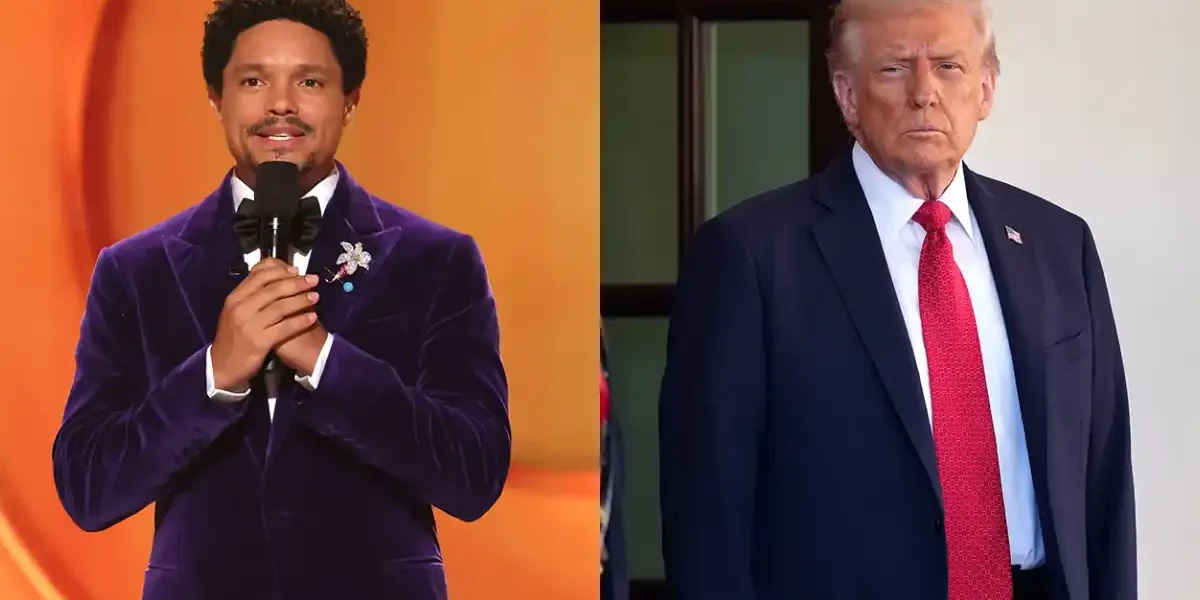
Donald Trump Threatens Legal Action Against Trevor Noah After Grammy Joke About Epstein

Los Angeles — Former U.S. President Donald J. Trump has sparked fresh controversy after threatening legal action against comedian and television host Trevor Noah, following a joke Noah made while hosting the 68th Annual Grammy Awards. The clash has reignited debates around free speech, satire, and the legal limits of comedy when it comes to public figures.
The dispute began during Sunday night’s ceremony in Los Angeles, where Noah — hosting the Grammys for the sixth time — delivered a monologue filled with political humor. One joke, in particular, drew widespread attention after it referenced Trump and disgraced financier Jeffrey Epstein.
During the broadcast, Noah quipped that Donald Trump might be searching for “a new island to hang out on” now that Epstein’s private island is gone, adding a reference to former President Bill Clinton. The remark was met with laughter inside the venue but quickly ignited backlash online.
Donald Trump Responds With Social Media Tirade
In the hours following the broadcast, Donald Trump reacted angrily on his social media platform, Truth Social, unleashing a series of posts attacking both Noah and the Grammys. He described the awards show as “virtually unwatchable” and labelled Noah a “poor, pathetic, talentless dope” while comparing him unfavorably to other late-night hosts.
More significantly, Trump accused Noah of making a “false and defamatory” claim. He insisted he has “never been to Epstein Island, nor anywhere close,” adding that he had never previously been accused of such a connection, even by mainstream media outlets.
Donald Trump went on to threaten legal action, declaring that he would be “sending lawyers” after Noah and suggesting he could seek substantial financial damages. “Get ready Noah, I’m going to have some fun with you!” he wrote, framing the threat in both combative and mocking terms.
The former president also referenced past legal victories and settlements involving major media organizations, suggesting those outcomes should serve as a warning to Noah and anyone else who criticizes him publicly.
Legal Experts Cast Doubt on Lawsuit Prospects
Despite Donald Trump’s forceful rhetoric, legal experts say any defamation lawsuit would face steep obstacles. Under U.S. law, public figures must meet a high bar to succeed in defamation cases, including proving that a statement was made with “actual malice” — meaning it was knowingly false or made with reckless disregard for the truth.
Satire, parody and exaggerated commentary are typically protected under the First Amendment, particularly when delivered in a comedic or entertainment setting such as an awards show monologue. Courts have historically been reluctant to treat jokes or rhetorical hyperbole as actionable defamation.
Legal analysts note that comedy aimed at politicians has long been a protected form of expression in the United States, making it unlikely that a lawsuit based on a punchline would advance far in court.
Epstein References Add Sensitivity
The joke’s impact was amplified by renewed public attention on Jeffrey Epstein, whose criminal activities and network of powerful associates have remained a subject of intense scrutiny. Recent document releases have reignited interest in Epstein’s connections, though neither Trump nor Clinton has been charged with crimes related to Epstein’s actions. Both men have denied any wrongdoing.
While Trump has previously acknowledged social interactions with Epstein in the past, he has repeatedly denied visiting Epstein’s private island or engaging in illegal conduct.
Politics and Entertainment Collide Again
Donald Trump’s response reflects his long-running and often combative relationship with media figures, comedians and entertainers. Over the years, he has repeatedly attacked journalists, late-night hosts and television personalities, frequently threatening lawsuits over criticism or satire.
Some of those threats have resulted in legal action or settlements, while others have faded without formal cases being filed. Critics argue that such threats are designed to intimidate and discourage criticism, while supporters say Donald Trump is justified in defending himself against what they view as unfair attacks.
Public Reaction Divided
Reaction to the controversy has been swift and polarized. Supporters of Donald Trump have praised his pushback, arguing that jokes referencing Epstein cross a line and risk spreading damaging allegations. Others have criticized Trump’s legal threat as an overreaction and a challenge to free speech.
On social media, many users mocked the idea of suing a comedian over an awards-show joke, while others debated whether satire involving serious criminal figures should have limits.
What Comes Next?
As of now, Donald Trump has not formally filed a lawsuit, and it remains unclear whether his legal team will pursue the matter. Representatives for Trevor Noah have not issued a public response to Trump’s comments.
Whether the threat escalates into a legal battle or fades as another flashpoint in Trump’s ongoing feud with entertainers, the incident has once again highlighted the uneasy intersection of politics, comedy and the law — and the enduring power of a joke to dominate headlines.