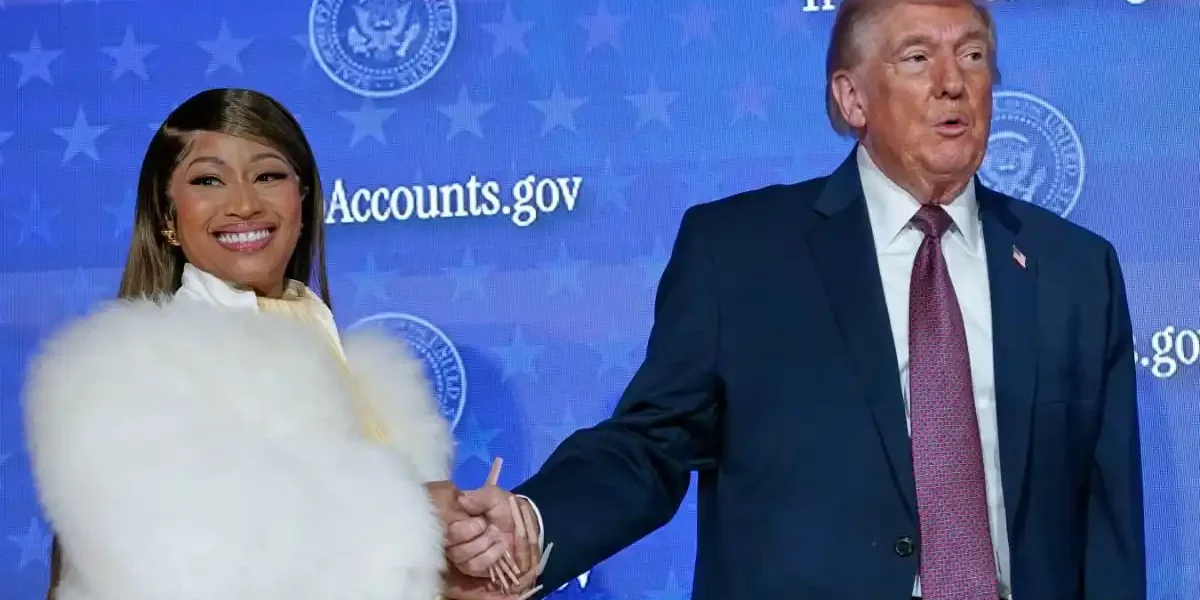

Nicki Minaj has never shied away from controversy, and her latest political moment has ignited one of the loudest debates of her career. The Grammy-nominated rapper and global pop icon now faces intense public scrutiny after she appeared alongside President Donald Trump and later shared a photo of what she called a “Trump Gold Card,” a credential tied to a newly promoted immigration initiative.
The episode unfolded this week after Minaj attended a high-profile Washington, D.C., event connected to Trump’s economic and immigration agenda. During the appearance, she openly praised the president and referred to herself as his “No. 1 fan,” a remark that quickly spread across social media and entertainment news outlets. Within hours, Minaj posted a cryptic image online showing herself holding a metallic card emblazoned with Trump’s name and captioned it simply, “Welp…”.
That single post triggered a political and cultural storm.
What Is the Trump “Gold Card”?
The Trump Gold Card stems from an immigration proposal promoted by the administration that would allow wealthy foreign nationals to fast-track U.S. residency — and potentially citizenship — through a large financial contribution to the U.S. Treasury. Although the proposal remains controversial and lacks full congressional approval, administration officials have described it as a way to attract “high-value global talent and investors” to the United States.
Publicly available details indicate that the program could require a contribution of up to $1 million, along with additional processing fees, in exchange for expedited permanent residency status. Critics argue that the policy monetizes citizenship by favoring wealthy applicants while the government tightens restrictions on asylum seekers and lower-income immigrants.
Minaj’s photo immediately raised questions about whether she participated in the program, received preferential treatment, or intended the image as a symbolic political statement.
Nicki Minaj’s Immigration Status Adds Fuel
Nicki Minaj, born Onika Tanya Maraj in Trinidad and Tobago, moved to the United States as a child and has lived there for decades. In past interviews, she has said that she was not formally a U.S. citizen, despite paying taxes and maintaining permanent resident status.
After the backlash erupted, Minaj suggested online that she was finalizing her citizenship paperwork and implied that the administration provided the Gold Card without payment. The White House has not released official confirmation regarding her immigration status or the authenticity of the card, leaving the situation open to speculation.
Legal experts note that while high-profile individuals can sometimes receive expedited processing, federal law still governs all immigration benefits. Observers remain uncertain whether the card Minaj displayed represents a legal document, a ceremonial item, or a promotional symbol.
Fan Backlash and Industry Reaction
Nicki Minaj’s fanbase reacted swiftly and sharply along ideological lines. Some supporters praised her for aligning publicly with Trump and framed her stance as an expression of political independence in an industry often dominated by liberal viewpoints. Others voiced disappointment, pointing to Trump’s hardline immigration policies and long history of polarizing rhetoric.
Several fan accounts trended on social media with calls to boycott her music, while others defended her right to political affiliation. Entertainment commentators noted that Minaj’s public support for Trump marks a notable departure from the traditionally progressive positions of many mainstream hip-hop artists.
Inside the music industry, reactions have remained relatively muted. While few artists have commented publicly, media analysts suggest that Minaj’s political alignment could influence brand partnerships, award show appearances, and her relationship with parts of her audience.
Politics, Celebrity, and Optics
The controversy highlights the increasingly blurred lines between celebrity culture and American politics. In recent years, entertainers have taken visible roles in campaigns, advocacy efforts, and policy debates. Minaj’s appearance stands out for both its timing and symbolism, particularly as immigration remains one of the country’s most divisive issues.
Critics argue that promoting a wealth-based immigration initiative sends a damaging message during a period of heightened deportations and border enforcement. Supporters counter that economic-driven immigration has long played a role in U.S. policy and that celebrities should not face pressure to remain politically silent.
What Comes Next?
So far, neither the White House nor the Department of Homeland Security has issued a detailed statement clarifying Minaj’s involvement with the Gold Card program. Meanwhile, the rapper has continued to post intermittently online, neither fully addressing the controversy nor backing away from it.
Whether this moment will carry lasting consequences for Minaj’s career remains uncertain. What remains clear is that her Gold Card post has reignited national conversations about wealth, immigration, and the influence celebrities wield in modern political discourse.
In an era when a single image can dominate headlines, Nicki Minaj has once again demonstrated her ability to command attention — even when that attention arrives with intense scrutiny.